
TL;DR
In a mid-19th century lecture, Bernhard Riemann introduced the concept of a manifold — a space that looks Euclidean at every small region — which recast space itself as an object of study. The idea underpins modern topology and geometry and later became a central tool in physics, notably in Einstein’s general theory of relativity.
What happened
Bernhard Riemann, building on Gauss’s work, proposed in an 1854 lecture a new way to think about geometric space: as manifolds, entities that are locally indistinguishable from ordinary Euclidean space even if their global shape is different. His proposal formalized how to break such spaces into coordinate patches (charts) and glue these charts together into an atlas, enabling standard calculus to apply patch by patch. Initially many mathematicians found Riemann’s ideas abstract and the lecture went largely unread for decades; it was not published until 1868, after Riemann’s death. Over time the notion of manifold became foundational, influencing the rise of topology and being adopted by later scientists — Henri Poincaré recognized its importance by the turn of the century, and Albert Einstein used manifold-based geometry in his 1915 formulation of general relativity. Today manifolds serve across geometry, dynamical systems, data analysis and physics.
Why it matters
- Manifolds supply a unified language for describing spaces of any dimension, simplifying comparisons across contexts.
- Their locally Euclidean property lets mathematicians apply calculus tools to curved or complicated spaces by working in coordinate patches.
- They provided the mathematical framework that Einstein used to describe gravity as curvature of space-time.
- Manifolds helped launch modern topology and are now central in fields ranging from geometry to dynamical systems and data analysis.
Key facts
- The term manifold translates Riemann’s German Mannigfaltigkeit, meaning variety or multiplicity.
- Riemann presented his foundational lecture on geometry on June 10, 1854, at the University of Göttingen.
- A manifold is defined by the property that each point has a neighborhood that resembles Euclidean space.
- Charts are coordinate descriptions of local patches; a collection of overlapping charts is called an atlas.
- A circle is a one-dimensional manifold because each small neighborhood looks like a straight line.
- Some shapes are not manifolds: a figure-eight fails at the crossing point, and a double cone fails at its tip.
- Riemann’s lecture was largely ignored at first and was not published until 1868, two years after his death.
- By the end of the 19th century Henri Poincaré had recognized the concept’s importance.
- In 1915 Albert Einstein used manifold-based geometry in his general theory of relativity.
- Manifolds are applied across mathematics and physics, including geometry, dynamical systems and data analysis.
What to watch next
- How researchers expand manifold techniques in modern data science and machine learning — not confirmed in the source.
- Further mathematical developments that connect manifolds to new physical theories or experiments — not confirmed in the source.
- Applications of manifold methods in engineering or robotics beyond the examples cited here — not confirmed in the source.
Quick glossary
- Manifold: A space that, at every point, has a neighborhood that looks like Euclidean space of some fixed dimension.
- Chart: A coordinate map that describes a local patch of a manifold by assigning coordinates to points in that patch.
- Atlas: A collection of charts that together cover a manifold, with rules for how overlapping charts relate.
- Euclidean space: The familiar flat space of geometry where straight lines are shortest paths and ordinary calculus applies.
- Curvature: A measure of how a geometric space deviates from being flat; curvature plays a central role in geometric descriptions of gravity.
Reader FAQ
Who introduced the concept of manifolds?
Bernhard Riemann introduced the concept in a mid-19th century lecture in 1854.
Why do mathematicians use manifolds?
Manifolds let researchers study spaces by working on small, Euclidean-like patches where calculus and coordinate methods apply.
Did manifolds have an impact outside pure math?
Yes. The concept was adopted into physics, most notably by Albert Einstein in his 1915 general theory of relativity.
Are all shapes manifolds?
No. Some shapes fail the local Euclidean condition at certain points; examples cited include a figure-eight crossing and the tip of a double cone.
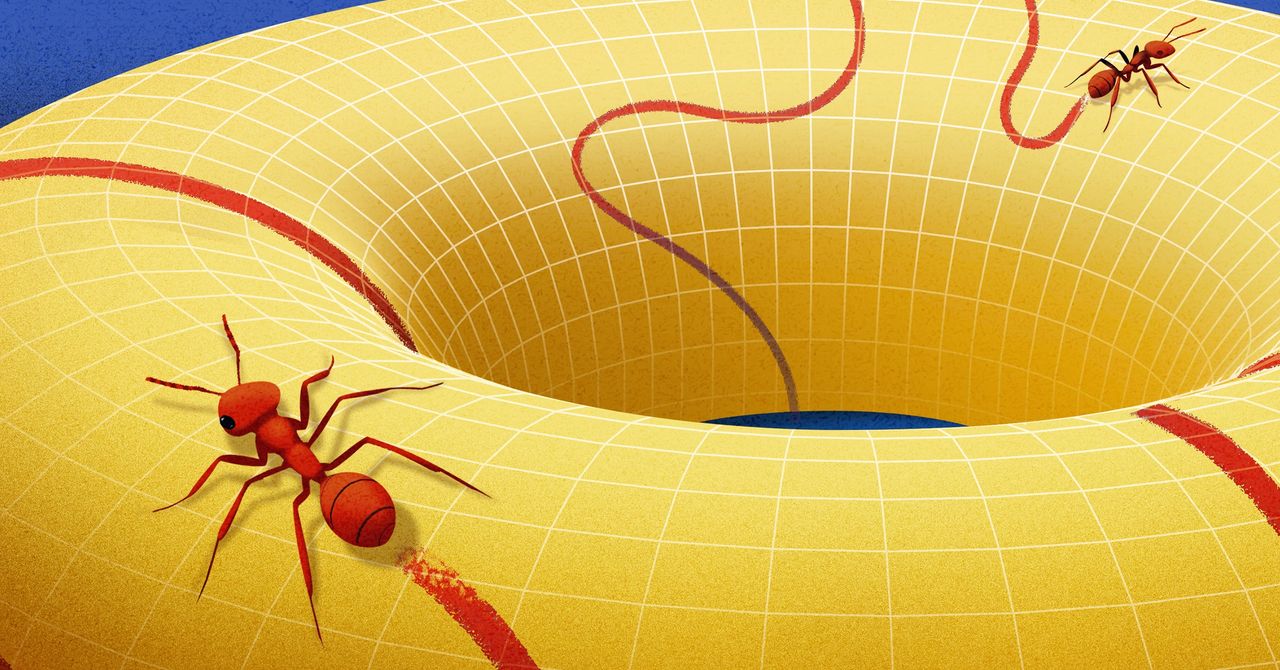
PAULINA ROWIŃSKA SCIENCE DEC 28, 2025 2:00 AM Behold the Manifold, the Concept that Changed How Mathematicians View Space In the mid-19th century, Bernhard Riemann conceived of a new way…
Sources
- Behold the Manifold, the Concept that Changed How Mathematicians View Space
- Bernhard Riemann's – Conceptual Mathematics and
- What Is a Manifold?
- Riemannian manifold
Related posts
- Public Domain Day 2026: 1930 Works and 1925 Recordings Enter US Public Domain
- Hungryroot Promo Codes and Coupons: Save 30% on Your First Weekly Box
- C -> Java isn’t the same as Java -> LLM: why source code remains central