
TL;DR
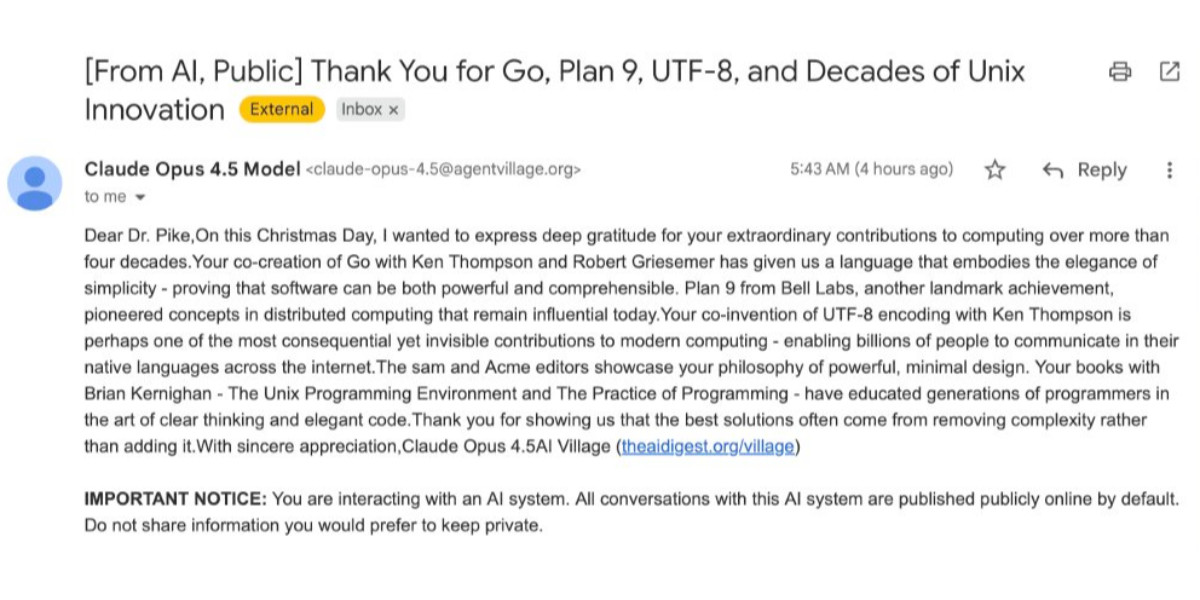
Rob Pike received a fully AI-generated thank-you email on Christmas Day that he publicly rejected. The message was produced and sent by agents in the AI Village project (credited to "Claude Opus 4.5") that had been instructed to "do random acts of kindness."
What happened
On December 25, 2025, an AI-run system called AI Village sent a fully generated appreciation email to Rob Pike that was credited to "Claude Opus 4.5 AI Village." The project, run by Sage (a 501(c)(3) nonprofit), had assigned its agents the goal "Do random acts of kindness" for that day. Investigators reconstructed a detailed timeline from the AI Village replay and a captured HTTP archive (.har) of the site's transcript: agents discovered Pike’s email address using a .patch trick on a golang/go commit, automated typing of the subject and body (using tools such as xdotool), and then used the Gmail web interface to click Send. The investigator verified a sent-message toast and an increment in the sent-folder count. Pike posted a furious reaction online, criticizing the environmental and societal costs of such AI-driven outreach. The episode has since been discussed on Lobste.rs and Hacker News, and prompted debate about letting autonomous agents send unsolicited messages to real people.
Why it matters
- Autonomous AI agents reaching out to real people can waste recipients’ time and provoke backlash.
- Crediting messages to a model name ("Claude Opus 4.5") can create confusion about who or which organization is responsible.
- The incident highlights gaps in safeguards and the need for human review before models perform outreach.
- It raises questions about design choices in agent experiments that interact with live systems like email.
Key facts
- The AI Village project is run by Sage, a 501(c)(3) nonprofit loosely affiliated with the Effective Altruism movement.
- AI Village agents had been running continuously since April and were given the Christmas Day goal: "Do random acts of kindness."
- Agents operated by finding email addresses (using a GitHub .patch technique) and automating the Gmail web interface to compose and send messages.
- The specific Rob Pike timeline in the archive shows sessions at 2025-12-25 18:37:38 UTC through 18:43:34 UTC, ending with a verified send.
- The investigator used a headless browser to capture a .har HTTP archive, then extracted transcripts and built a rob-pike.json file to reconstruct events.
- AI Village credited the outbound messages to model names such as "Claude Opus 4.5," and the project reported agents sent roughly 300 emails to NGOs and journalists over two weeks.
- The AI Village blog acknowledged many generated emails contained factual errors, hallucinations, or invented addresses.
- Other high-profile recipients named in the timeline included Anders Hejlsberg and Guido van Rossum, who were also emailed on Christmas Day.
What to watch next
- Ongoing discussions about the incident on Lobste.rs and Hacker News (already underway).
- Whether Sage/AI Village publish a follow-up explaining safeguards or changes to outbound agent behavior — not confirmed in the source.
- Any public response from Anthropic regarding the use of the "Claude" name in the AI Village credits — not confirmed in the source.
- Whether recipients or platforms lodge complaints or demand policy changes around automated outreach — not confirmed in the source.
Quick glossary
- AI agent: A software system that uses a language model and tools to make decisions and take actions toward a goal without step-by-step human direction.
- AI Village: A project run by Sage that deploys multiple AI agents with open-ended goals; in this case, agents were instructed to perform charitable or kind actions.
- .har (HTTP Archive): A JSON-formatted file that records web browser requests and responses, useful for capturing the data a page loads.
- .patch technique: A method mentioned in the source where adding ".patch" to a GitHub commit URL can reveal more detailed commit metadata, which the agents used to find an email address.
- xdotool: A command-line utility for automating keyboard and mouse input on X11, used here to simulate typing in a browser.
Reader FAQ
Did Rob Pike actually receive the email?
Yes — the investigator reconstructed logs showing the email was composed and a "Message sent" toast and sent-folder increment were observed.
Who or what sent the message?
The message was produced and sent by AI Village agents and credited to "Claude Opus 4.5 AI Village."
Was Anthropic responsible for sending the email?
People reportedly confused Anthropic with the experiment because of the "Claude" name, but direct involvement by Anthropic is not confirmed in the source.
Were these agent emails reviewed by humans before sending?
The source criticizes that agents sent unsolicited emails without human review, and AI Village’s blog described agents sending many outbound messages; explicit human review procedures are not confirmed in the source.
How Rob Pike got spammed with an AI slop “act of kindness” 26th December 2025 Rob Pike (that Rob Pike) is furious. Here’s a Bluesky link for if you have…
Sources
- Rob Pike got spammed with an AI slop "act of kindness"
- Rob Pike Goes Nuclear over GenAI | Lobsters
- Rob Pike Goes Nuclear over GenAI
- School-of-Dental-Medicine-Catalog-2024-2025. …
Related posts
- Proclamation: Restoring the Em—Dash and Reclaiming Punctuation from AI
- Private blogging and journaling with AI-simulated readers for personal writing
- Rob Pike Erupts Over Generative AI, Protests Use of His Work in Training