
TL;DR
A user installed Asahi Linux on a MacBook Air M2 and configured the Sway window manager on a Fedora minimal install. They adjusted display and input settings for the M2 notch, installed common Sway packages, and report a very responsive system with good touchpad support but shorter battery life than macOS under heavy use.
What happened
The author purchased a MacBook Air M2 and used the Asahi Linux installer (a provided one-liner) to put Linux on the machine; they noted the Asahi project does not support chips newer than M2. Because of limited storage and a desire to run Sway, they installed Fedora minimal as the base. Network setup was done with nmcli, followed by installing a Sway desktop and a set of user packages (including fish, alacritty, rofi, i3status, and firefox). They pulled their dotfiles and adjusted configurations for the MacBook. To reclaim the screen area around the notch they enabled it with a grubby kernel argument and set the Sway bar at the top with a height of 56px. They also tweaked i3status to read battery information from macsmc and blocked the mouse from entering the top bar region. The writer reports smooth performance, excellent touchpad behavior, successful use of an ARM64 SDK after extracting a .deb package, and measured battery drain from 100% to 60% in about 4.5 hours under heavy use.
Why it matters
- Demonstrates that Asahi Linux plus a tiling Wayland compositor (Sway) can be used as a daily driver on Apple Silicon M2 hardware.
- Highlights practical desktop adjustments required for Mac-specific hardware features such as the notch and macsmc battery interface.
- Shows packaging and architecture friction when third-party ARM64 software is distributed as .deb files on RPM-based distros.
- Provides a real-world datapoint on performance and battery trade-offs compared with macOS on the same device.
Key facts
- Device: MacBook Air M2 (13.6", 16 GB RAM, 256 GB SSD mentioned as available for $750 at time of writing).
- Asahi Linux installer used via a one-line Terminal command; Asahi support stated as not covering anything newer than M2.
- Author chose Fedora minimal to conserve storage while running Sway.
- Network was configured with nmcli commands to list and connect to Wi‑Fi.
- Installed packages included a Sway desktop environment plus tools like fish, alacritty, rofi, rclone, pavucontrol-qt, i3status, mako, syncthing, and firefox.
- Notch area was re-enabled using grubby with apple_dcp.show_notch=1; Sway bar height set to 56px to accommodate the notch.
- i3status was modified to include a battery entry pointing at /sys/class/power_supply/macsmc-battery/uevent so battery status is readable.
- The author extracted an ARM64 .deb for the Alkeria SDK with bsdtar after alien failed, and found compilation performance to be very fast on the M2.
- Reported battery drain: from 100% to 60% after roughly 4.5 hours of heavy activity (high brightness and compiling).
- File copy during initial install was slow, reported at about 150 KB/s when copying root.img and boot.img.
What to watch next
- Whether Asahi Linux adds official support for Apple chips newer than M2 — not confirmed in the source.
- Improvements or integrations that automatically handle the notch and top-bar behavior in Wayland compositors — not confirmed in the source.
- Potential fixes or tooling to ease installing ARM64-distributed .deb packages on RPM-based distributions (or a working alien setup) — not confirmed in the source.
- Battery life tuning and driver optimizations that could narrow the gap with macOS energy efficiency — not confirmed in the source.
Quick glossary
- Asahi Linux: A community project to port Linux to Apple Silicon Macs, providing kernels, boot support, and device drivers for Apple hardware.
- Sway: A tiling Wayland compositor designed to be compatible with i3 configuration and workflow, used as a lightweight desktop environment.
- nmcli: A command-line tool for controlling NetworkManager to configure and manage network connections.
- grubby: A utility for configuring kernel command-line options and updating bootloader entries on some Linux distributions.
- i3status: A status bar generator commonly used with tiling window managers to display system information such as time, network, and battery.
Reader FAQ
Can Asahi Linux run on the M2 MacBook Air?
Yes; the author installed Asahi Linux on an M2 MacBook Air. The source also notes Asahi does not support chips newer than M2.
Is Sway usable as a daily driver on this hardware?
The author uses Sway daily and reports very responsive performance and a high-quality touchpad experience.
Do macOS features like the notch work under Asahi + Sway?
The notch area was disabled by default; the author re-enabled it via a grubby kernel argument and adjusted the Sway bar height to 56px.
How is battery life compared to macOS?
The author observed battery drop from 100% to 60% in about 4.5 hours under heavy use, and noted this is less than the ~15 hours reported on macOS — the 15-hour figure is presented by the author as a macOS comparison.
Can I install third-party ARM64 software easily?
The author installed an ARM64 SDK by extracting a .deb with bsdtar after alien failed to convert the package for Fedora.
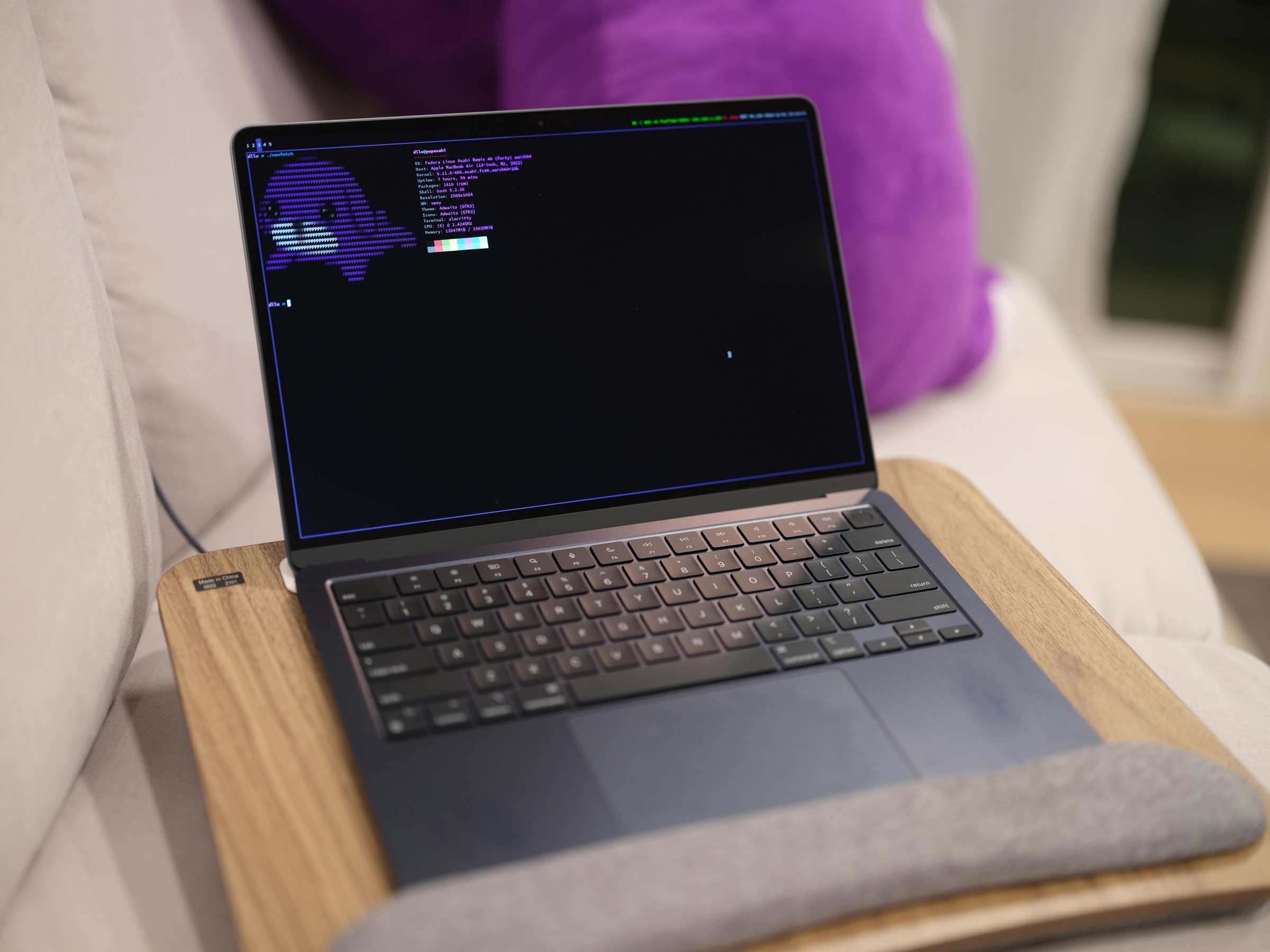
ASAHI LINUX WITH SWAY ON THE MACBOOK AIR M2 2024-12-01 I bought a MacBook Air M2. As of writing, it’s very affordable with the 16 GB RAM, 256 GB SSD,…
Sources
- Asahi Linux with Sway on the MacBook Air M2
- M2 Series Feature Support
- Its been more than a year I'm running asahi on my …
- Asahi Linux
Related posts
- Study in mice finds restoring brain NAD+ can reverse advanced Alzheimer’s
- SubMicro Engine: Ultra-Low-Latency Trading System Achieves Sub-Microsecond E2E
- Why quantum error correction may trigger a near-term FOOM in qubit quality