
TL;DR
Researchers and makers Augustin Bielefeld and Alexander Willer spent more than a year building a small electronics production line in an office in Hamburg and documented their experience in a 39-minute 39c3 talk. They focused on practical hurdles—paste printing, batch reflow, inventory and DfM—and highlighted OpenPnP and open-source tooling as central enablers.
What happened
At 39c3, Augustin Bielefeld and Alexander Willer presented a 39-minute session about establishing in-house electronics manufacturing from the ground up. Over more than a year they assembled a production line inside an office in Hamburg, then tested and refined processes for high-mix/low-volume runs. The talk walks through machine acquisition and setup, lessons learned, and the costs involved; practical production topics such as stencil printing and batch reflow soldering at scale (they reported handling up to 50 batches per day); and process issues like component inventory, tracking, and design-for-manufacturability. OpenPnP — an open-source pick-and-place platform — is presented as a key enabler, including proposed changes and integration work with Siemens Siplace Feeders. The presenters framed the effort as part of a broader push to make European electronics manufacturing accessible to small firms and to reclaim ownership of production using open-source hardware and software.
Why it matters
- If viable, lower-cost in-house lines could enable small companies to reshore electronics manufacturing in Europe.
- Open-source tools like OpenPnP may reduce barriers to entry for automated PCB assembly.
- Documenting practical hurdles (paste printing, reflow, inventory) exposes costs and skills often hidden behind the claim that manufacturing requires massive CAPEX.
- The work positions small, innovative firms rather than large incumbents as potential drivers of industry relocation and change.
Key facts
- Talk presented by Augustin Bielefeld and Alexander Willer at 39c3.
- Video length: 39 minutes 30 seconds.
- Authors spent more than one year setting up a production line in an office in Hamburg.
- They covered machine acquisition, setup, costs, and operational learnings.
- Operational topics included paste printing, batch reflow soldering, component inventory, tracking, and DfM.
- They reported reflow and printing workflows at scale up to 50 batches a day.
- OpenPnP is highlighted as a central software enabler; presenters proposed changes and integrated Siemens Siplace Feeders with it.
- Presentation and materials are licensed under Creative Commons BY 4.0.
- Video assets and audio/subtitle tracks are available in multiple languages and formats for download.
What to watch next
- Whether the proposed changes to OpenPnP are adopted by the wider community — not confirmed in the source
- If other small companies replicate the Hamburg setup and whether that leads to broader reshoring in Europe — not confirmed in the source
- Actual, detailed cost and throughput benchmarks from their line that would prove economic viability at scale — not confirmed in the source
Quick glossary
- Batch reflow oven: A soldering oven that processes groups of assembled PCBs together through controlled heating cycles to melt solder paste and form solder joints.
- Stencil printing: A PCB assembly step where solder paste is applied to pads through a stencil to prepare for component placement and soldering.
- OpenPnP: An open-source software and firmware ecosystem for controlling pick-and-place machines used in automated PCB assembly.
- High-mix/low-volume manufacturing: Production characterized by many different product variants made in small batches, requiring flexible equipment and processes.
- DfM (Design for Manufacturability): Design practices that make a product easier and more cost-effective to manufacture.
Reader FAQ
Who gave this presentation?
Augustin Bielefeld and Alexander Willer.
Where did they set up the production line?
In an office located in Hamburg.
Do they provide exact cost figures for the setup?
They state they covered costs and learnings in the talk, but exact numeric figures are not confirmed in the source.
Is the project presented as open-source?
Yes. The presenters emphasize using open-source hardware and software and the talk is licensed under Creative Commons BY 4.0.
Does the talk prove that reshoring will happen in Europe?
not confirmed in the source
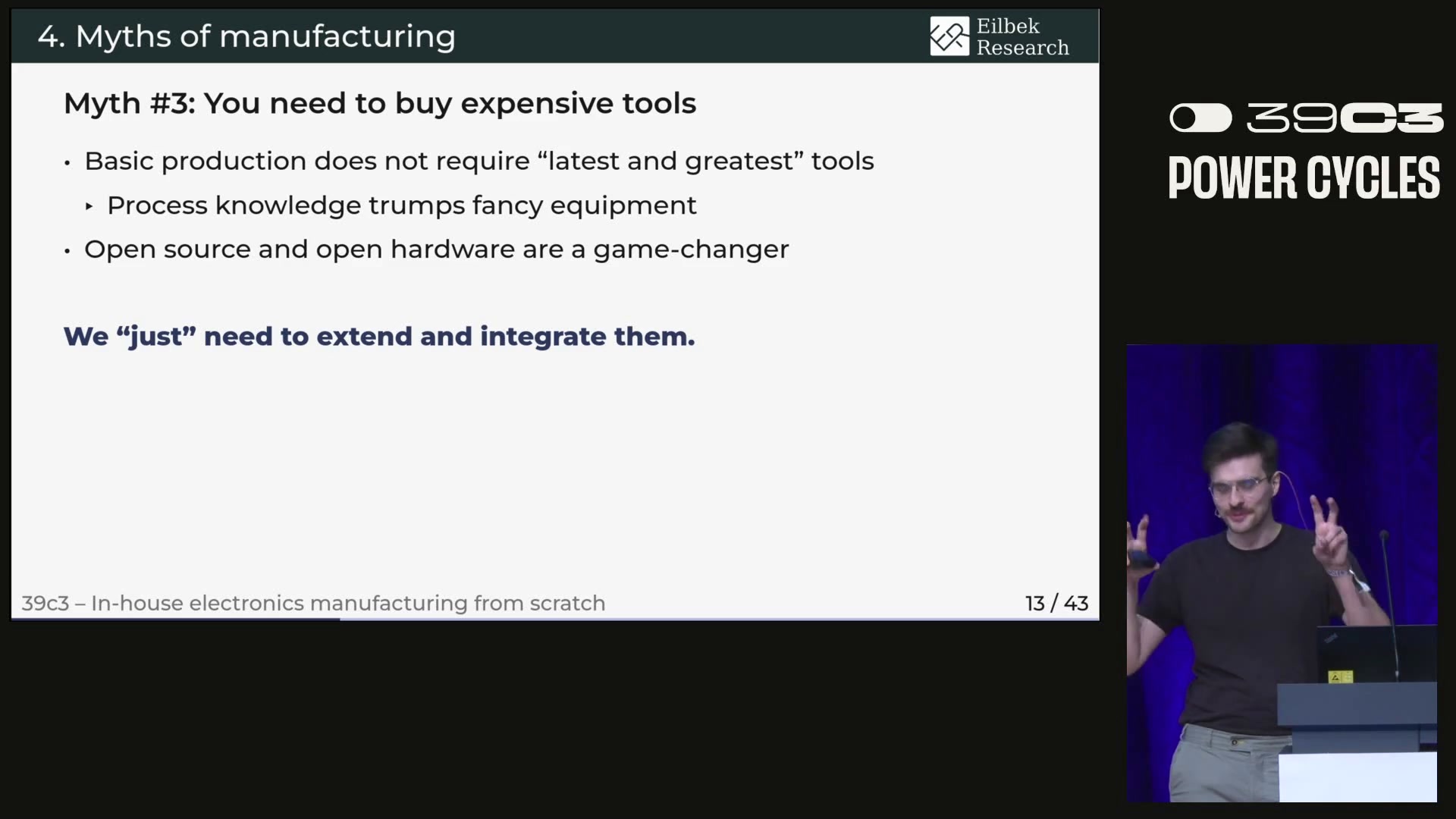
In-house electronics manufacturing from scratch: How hard can it be? Augustin Bielefeld and Alexander Willer Video Player 15 30 00:00 | 39:30 None eng (auto) 1.00x eng 1080p h264-hd (mp4)…
Sources
- 39c3: In-house electronics manufacturing from scratch: How hard can it be?
- How to manufacture my own electronic product
- Setting up for in house small runs of pcb assembly
- Electronics Lab Equipment: Kitting out a Lab from Scratch
Related posts
- Xfce is great — a long-time user’s case for keeping desktop simplicity
- Why Xfce Still Matters: A Longtime User’s Case for the Lightweight Desktop
- Reduced winter snowfall leaves Himalayas bare and raises water risks