
TL;DR
Speechify has launched its Voice AI Assistant on iOS after previously offering it on Chrome and the web, extending features beyond text‑to‑speech. The app uses a mix of third‑party models and in‑house models from a team of researchers, is cloud‑based for now, and the firm says it plans on‑device models and deeper automation in future updates.
What happened
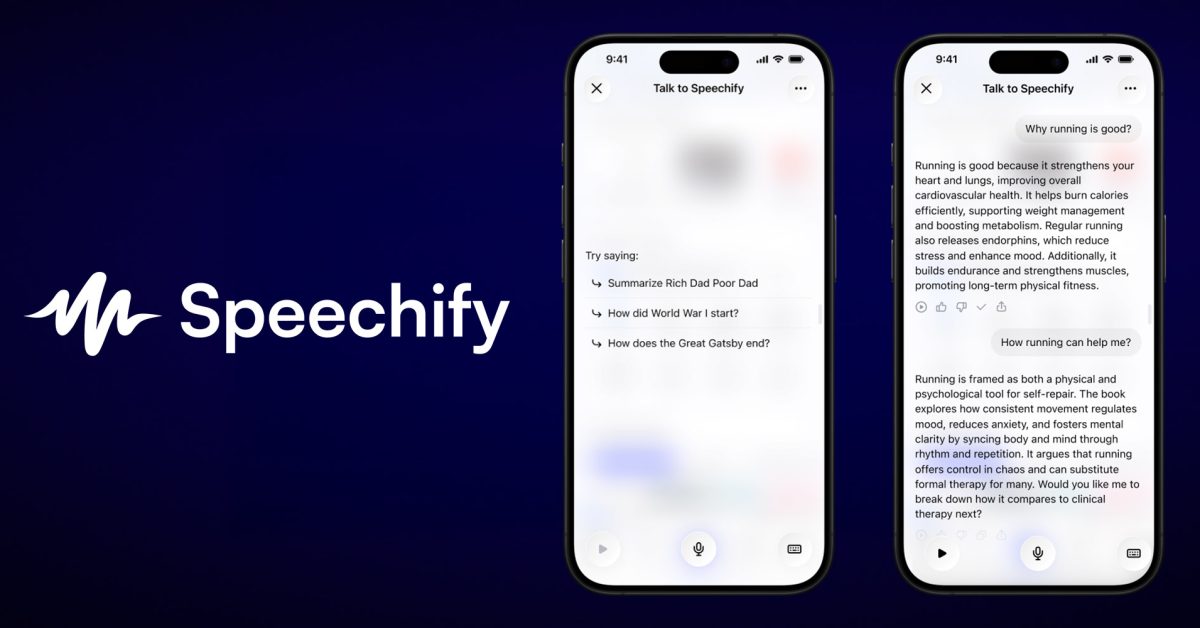
Speechify released a general‑purpose Voice AI Assistant for iPhone users, moving the product beyond its earlier Chrome and web availability. The iOS app lets users interact by voice to browse the web, hold multi‑turn conversations about the content of files and documents, generate podcasts from documents, and request tasks such as quizzes, lectures or summaries. The company says the assistant combines external models with proprietary models developed by a research team of more than 40 engineers and researchers. The current architecture runs in the cloud; Speechify says it is working toward on‑device model support and plans to add capabilities for more complex voice commands, notification management, and task automation like answering or making calls via user‑defined prompts. The release follows the company’s recent Voice Typing Dictation feature for Mac and is framed as a push to compete with established AI platforms and voice assistants.
Why it matters
- A voice‑first assistant on iOS expands Speechify’s scope beyond text‑to‑speech into broader productivity and content workflows.
- Cloud‑based operation enables immediate functionality but raises questions about latency, data handling and privacy compared with on‑device models.
- If it delivers on multi‑turn conversations tied to documents, the assistant could change how people study, research and review material by voice.
- Speechify positioning itself against major AI and voice platforms signals tighter competition in the assistant and generative AI space.
Key facts
- Speechify launched the Voice AI Assistant on iOS on Jan. 12, 2026.
- The assistant was previously available only on Chrome and the web.
- Features include voice web browsing, multi‑turn conversations about files/documents, podcast creation from documents, quizzes, lectures and summaries.
- Speechify uses a combination of third‑party models and proprietary models developed by a team of over 40 researchers and engineers.
- The product is cloud‑based at launch; the company says on‑device models are planned for future updates.
- The company is working toward support for more complex commands, notification management and automating tasks such as answering and making phone calls via user‑defined prompts.
- Speechify described the release as part of its effort to compete with platforms including ChatGPT, Gemini, Perplexity, Siri and Alexa.
- The iOS release follows Speechify’s recent Voice Typing Dictation feature for Mac introduced the prior month.
What to watch next
- Rollout and user adoption on iOS compared with Speechify’s web and Chrome user base — not confirmed in the source.
- Timeline and technical details for the planned on‑device models, including which capabilities will move off‑cloud — not confirmed in the source.
- When and how the app will implement notification management and automated phone‑call handling as those features are described as future work but no schedule was provided.
Quick glossary
- Voice AI assistant: A software agent that accepts spoken input and performs tasks, answers questions or converses using natural language processing and speech technologies.
- Cloud‑based: A system where computation and data storage occur on remote servers accessed over the internet rather than on a local device.
- On‑device model: An AI model that runs directly on a user’s device, which can reduce latency and limit data sent to external servers.
- Multi‑turn conversation: A dialogue format where the assistant and user exchange multiple back‑and‑forth turns, allowing context to persist across queries.
- Text‑to‑speech (TTS): Technology that converts written text into spoken audio.
Reader FAQ
Is Speechify’s Voice AI Assistant available on iPhone?
Yes. The company released the iOS version on Jan. 12, 2026, after offering it on Chrome and the web.
Does the assistant run on the device or in the cloud?
It is cloud‑based at launch. The company says on‑device models are planned for future updates.
Can the assistant already automate calls and manage notifications?
Not at launch. Speechify says it is working on support for those automations but provides no timeline.
Is Speechify claiming to replace Siri or ChatGPT?
Speechify positions the assistant to compete with platforms like ChatGPT, Gemini, Siri and Alexa, but whether it replaces them is not confirmed in the source.
Apple confirms Google’s Gemini will power new Siri features Chance Miller Jan 12 2026 SPEECHIFY Speechify launches Voice AI Assistant on iOS Marcus Mendes | Jan 12 2026 – 10:51 am…
Sources
- Speechify launches Voice AI Assistant on iOS
- Speechify Launches On-Device iOS AI Voices for Offline …
- Speechify – Voice AI Assistant – App Store – Apple
- Speechify Announces Free Voice Typing Dictation and …
Related posts
- Apple releases macOS Tahoe 26.3 beta 2 for developers — what to expect
- Anker expands into whole-home backup market with large Solix E10 battery system
- Open-Meteo: free, open-source global weather API available for non-commercial use