
TL;DR
Incat of Tasmania has launched Hull 096, a 130-metre ferry the company says is the world’s largest battery-electric ship. Built for Buquebus, the vessel is intended to run between Buenos Aires and Uruguay and carries large battery capacity claimed to exceed prior maritime installations.
What happened
Incat, a shipbuilder based in Hobart, Tasmania, launched Hull 096 on Friday, a 130-metre vessel the company describes as the world’s largest battery-powered ship. The craft was built for South American ferry operator Buquebus and is intended to service the river crossing between Buenos Aires and Uruguay. Incat says the ferry can carry up to 2,100 passengers and 225 vehicles. The ship is fitted with over 250 tonnes of batteries and more than 40 megawatt-hours of installed energy storage, which the company reports is linked to eight electrically driven water jets. Incat executives labelled the project their most complex to date and framed the vessel as evidence that large-scale, low-emission maritime transport is achievable now. Dozens of onlookers attended the Hobart launch, and the company said the ferry will depart for South America to begin its service.
Why it matters
- Demonstrates a large-scale application of battery-electric propulsion in passenger ferries.
- If successful, could provide operational data to inform electrification of other ship types.
- Targets emissions from a sector responsible for about 3% of global greenhouse gas output, per UNCTAD.
Key facts
- Builder: Incat, based in Hobart, Tasmania.
- Vessel name/designation: Hull 096.
- Length: 130 metres.
- Passenger capacity: up to 2,100 people.
- Vehicle capacity: up to 225 vehicles.
- Battery mass: more than 250 tonnes of batteries installed.
- Installed energy capacity: in excess of 40 megawatt-hours.
- Propulsion: power delivered to eight electrically driven water jets.
- Client/operator: contracted by ferry operator Buquebus to run between Buenos Aires and Uruguay.
- Incat claims the vessel’s energy storage is four times larger than previous maritime installations.
What to watch next
- Timing and schedule for the ferry’s commercial entry into service: not confirmed in the source.
- How the batteries perform in operational service and actual voyage range under load: not confirmed in the source.
- Details of shore charging infrastructure and turnaround procedures at ports: not confirmed in the source.
Quick glossary
- Battery-electric ship: A vessel whose primary propulsion and onboard energy needs are supplied by rechargeable battery systems rather than internal combustion engines.
- Megawatt-hour (MWh): A unit of energy equal to one megawatt (1 MW) of power sustained for one hour; commonly used to express large-scale battery capacity.
- Water jet propulsion: A marine propulsion method that generates thrust by expelling a high-speed jet of water, often powered by electric motors or turbines.
- Ferry operator: A company or organisation that runs scheduled passenger and vehicle transport services across a body of water.
Reader FAQ
Is Hull 096 fully battery-electric?
Yes. The company states the vessel will operate entirely on battery-electric power.
Who will operate the ferry and on what route?
The ferry was built for Buquebus and is intended to run between Buenos Aires (Argentina) and Uruguay.
When will Hull 096 begin commercial service?
not confirmed in the source
How long will crossings or charging stops take?
not confirmed in the source
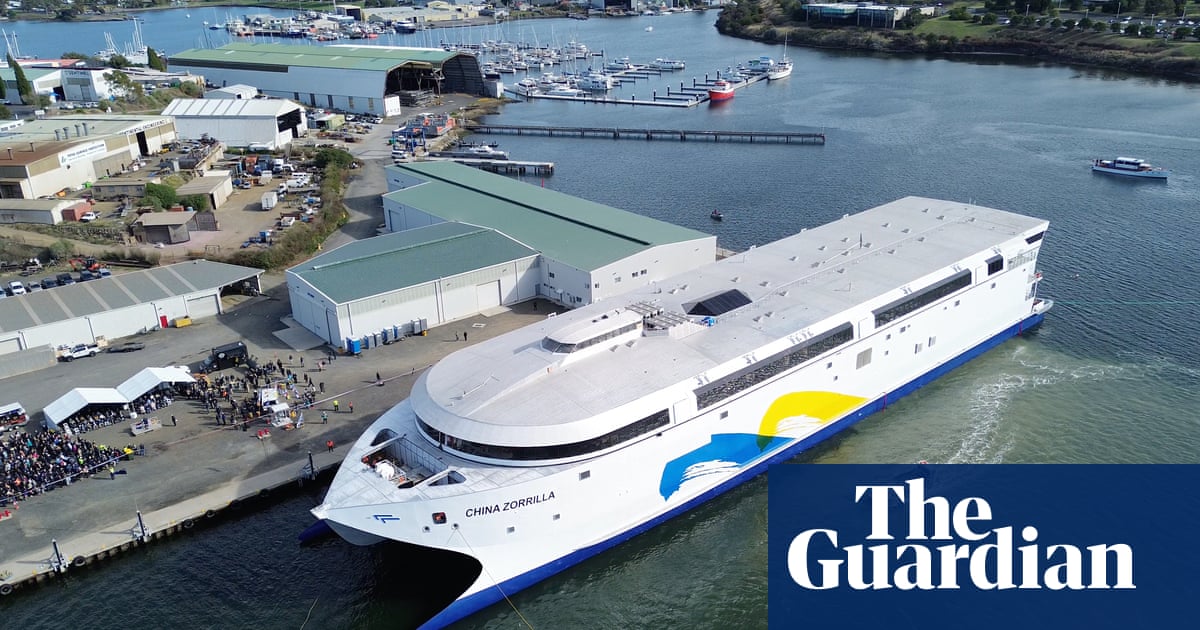
View image in fullscreen Hull 096, an electric ship constructed by Australian boatbuilder Incat, was contracted by the South American ferry operator Buquebus to run between Buenos Aires and Uruguay….
Sources
- Worlds largest electric ship launched by Tasmanian boatbuilder
- Incat Launches the World's Largest Battery-Electric Ship
- World's largest '100 per cent electric' ship launched by …
- Incat launches China Zorrilla, world's largest electric ship
Related posts
- flow5 Goes Open Source; v7.54 Adds Gmsh Integration and Refactor
- Upgrade your car with an 11-inch Android Auto display and built-in 4K dashcam
- Monash and Yale develop non-invasive approach to boost brain lymphatics