
TL;DR
A Texas A&M philosophy professor was told to remove passages from Plato’s Symposium and material on race and gender from his upcoming course or teach a different class, under a review citing “Rule 08.01.” The professor submitted his syllabus, disputed that it advocates an ideology, and cited constitutional and academic freedom protections.
What happened
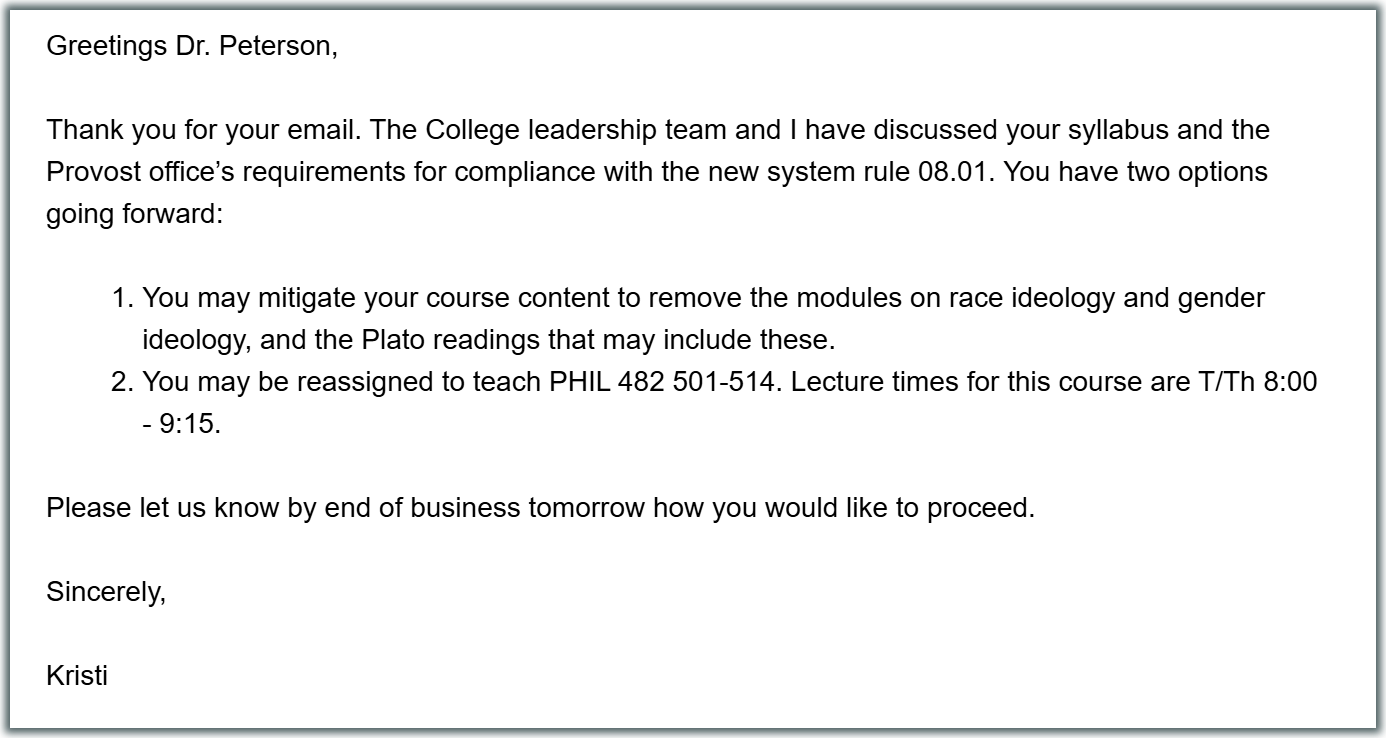
Martin Peterson, a philosophy professor at Texas A&M, says university officials told him to remove certain race- and gender-related material and passages from Plato’s Symposium from his “Contemporary Moral Problems” syllabus or to offer a different course, and gave him one day to decide. The instruction was communicated by the department chair, Kristi Sweet, referencing a review under “Rule 08.01” and the college leadership team led by interim dean Simon North. The disputed Plato excerpts included Aristophanes’ myth of split humans and Diotima’s ladder of love; other assigned material came from Ethics: Theory and Contemporary Issues (10th edition) by Andrew Fiala and Barbara MacKinnon. Peterson had been contacted on December 19 about a syllabus review; he replied that his course is intended to teach students how to evaluate arguments rather than to advocate an ideology, and he cited constitutional protections and norms of academic freedom. Documents and emails referenced in the report were provided by Peterson to the outlet.
Why it matters
- Raises questions about academic freedom and curricular oversight at a public university.
- Touches on possible First Amendment concerns when administrators review or restrict course content.
- Signals potential tension between new campus policies (cited as Rule 08.01) and established teaching practices.
- May affect how faculty design core curriculum courses if review standards differ for those classes.
Key facts
- Professor affected: Martin Peterson, philosophy faculty at Texas A&M.
- Instruction: remove race/gender material and passages from Plato’s Symposium or teach a different course, with one day to respond.
- Policy cited in communications: “Rule 08.01.”
- Message relayed by department chair Kristi Sweet, referencing the college leadership team led by interim dean Simon North.
- Plato excerpts identified: passages from the Symposium, including Aristophanes’ myth of split humans and Diotima’s ladder of love.
- Other assigned text: Ethics: Theory and Contemporary Issues (10th ed.) by Andrew Fiala and Barbara MacKinnon.
- Professor was contacted about syllabus review on December 19 and described the process as a “mandatory censorship review.”
- Peterson replied that the course does not advocate any ideology and referenced constitutional and academic freedom protections.
- Source materials (emails, syllabus) were provided to the reporting outlet by Peterson.
- Report authored by Justin Weinberg on Daily Nous, published January 6, 2026.
What to watch next
- Whether Texas A&M will apply similar restrictions to other courses or faculty — not confirmed in the source.
- Any formal response from the university administration, the philosophy department chair, or interim dean Simon North — not confirmed in the source.
- Potential legal or formal academic freedom challenges by the affected professor or faculty organizations — not confirmed in the source.
Quick glossary
- Rule 08.01: A university policy referenced in communications about syllabus review; the source does not provide the full text or specific provisions of the rule.
- Plato's Symposium: A classical philosophical dialogue that explores different accounts of love, including speeches such as Aristophanes’ myth and Diotima’s ladder of love.
- Academic freedom: The principle that scholars should have latitude to teach, discuss and research ideas without undue institutional restriction, subject to professional norms and applicable law.
- First Amendment: The amendment to the U.S. Constitution that, among other protections, safeguards freedom of speech and expression from government restriction; its application to public university course content can raise legal questions.
Reader FAQ
Was Plato banned across Texas A&M?
Not confirmed in the source.
Which passages from Plato were targeted?
The report names passages from the Symposium, including Aristophanes’ myth of split humans and Diotima’s ladder of love.
Who communicated the decision to the professor?
The department chair, Kristi Sweet, relayed the message from the college leadership team headed by interim dean Simon North.
Has the professor filed a legal challenge?
Not confirmed in the source.
Does the university cite a specific rationale for the removal?
The communications referenced “Rule 08.01” and a recent policy change, but the source does not detail the university’s stated rationale.
Texas A&M Bans Plato By Justin Weinberg. January 6, 2026 at 9:34 pm Drop the race and gender material from your course and the Plato readings, or teach a different…
Sources
- Texas A&M bans part of Plato's Symposium
- Texas A&M University
- Texas A&M University-Corpus Christi: Welcome Home
Related posts
- Documents Show Sugar Industry Pushed Focus on Saturated Fat Over Sugar
- Illinois says mapping error exposed personal data of over 600,000 patients
- Records show mess left after RFK Jr. dumped a dead bear cub in Central Park