
TL;DR
Researchers built a "Riven Explorer" to compare multiple renders that can exist for a single in-game viewpoint in Riven (1997). Side-by-side pixel diffs and animated toggles expose visual anomalies, splices, and patches that reveal development and rendering artifacts across the game's cards.
What happened
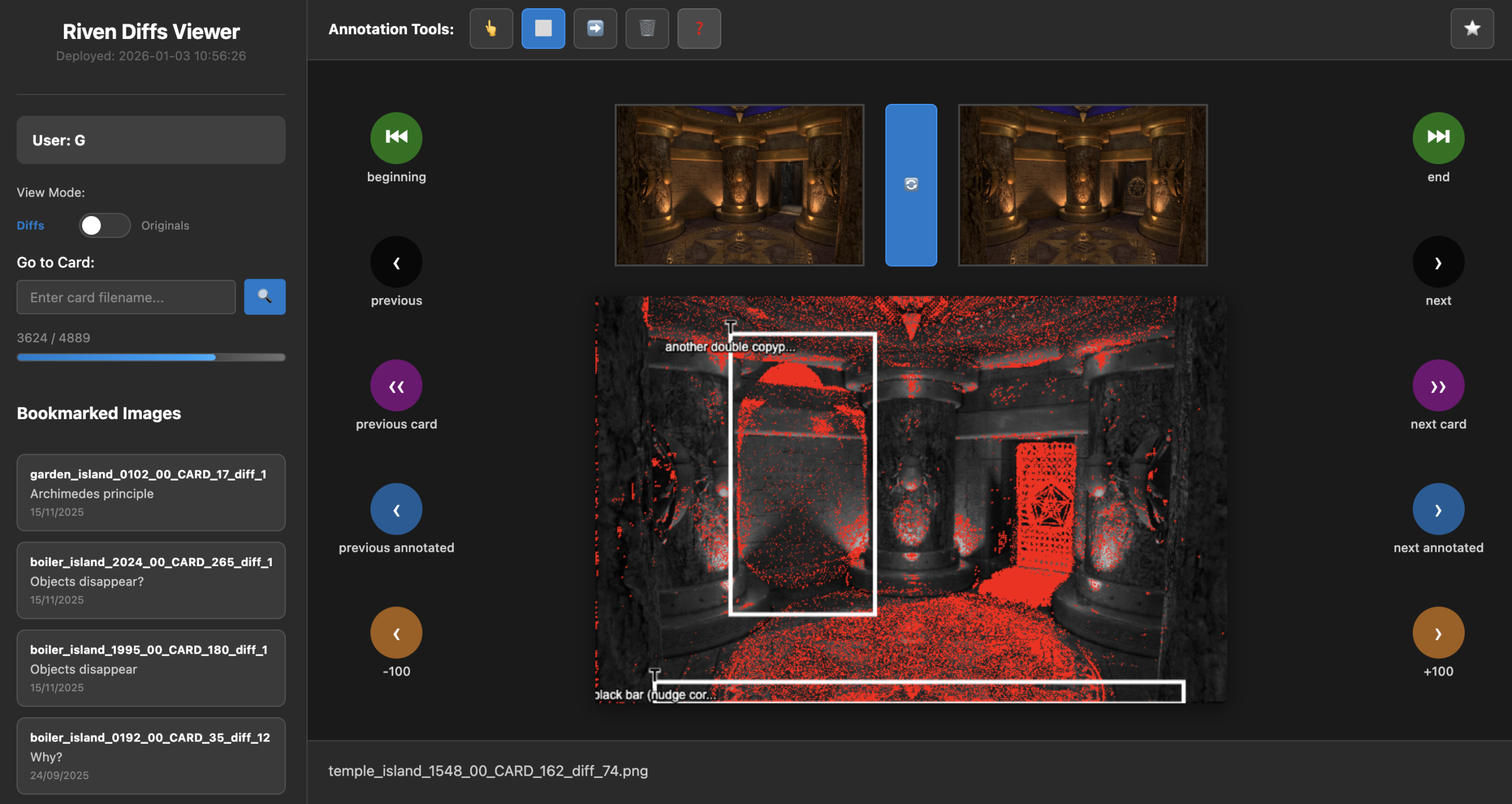
Researchers examined Riven’s rendered images with a purpose-built tool that lines up and compares the multiple images the Mohawk engine can associate with a single in-game card. Unlike Myst’s static one-image-per-card model, Riven supports several renders per viewpoint depending on the worldstate; the Explorer produces pairwise comparisons (diffs) between those renders. It highlights mismatches with pixel-differential overlays (red highlights) and an animated flicker mode that alternates the two images rapidly. Systematic review turned up numerous anomalies: geometry shifts and occlusion errors around spinning domes on Jungle Island, foliage changes on J127, a visible splice around a prison doorjamb, and patches for the submarine and dock seen in J181. The analysis cites use of asset extraction (Riveal) and bases card numbers on the English 1.2 DVD build.
Why it matters
- Reveals how Riven’s engine stored multiple rendered states per location, giving new insight into the game’s runtime model.
- Makes visible development-stage changes and editing decisions that are otherwise invisible during normal play.
- Helps preservationists and modders understand where patches and splices were used in finished assets.
- Highlights visual inconsistencies that document the practical limits and trade-offs of 1990s pre-rendered scene production.
Key facts
- Riven uses the Mohawk engine, which can associate multiple rendered views with a single card (viewpoint).
- The Riven Explorer compares every pair of renders for a card and visualizes differences via pixel diffs and animated toggles.
- Pixel differential rendering produces a black-and-white composite with red pixels marking mismatches; animated comparison alternates images to show motion.
- The number of diffs for N renders follows the triangular number sequence (0, 1, 3, 6, 10 …).
- Terminology used in the research: ANOMALY, CARD, WORLDSTATE, PATCH, SPLICE, and FMV.
- Patches are rectangular overlays used at runtime to avoid rendering every possible configuration; splices are edits embedded inside a finished render.
- Examples cited: hinge occlusion and polygon-count differences around spinning domes (cards J121, J124, J133, J154, J421), foliage changes on J127, and a splice visible in J191.
- When standing on card J181 there are two patches for the submarine and for dock 5; timing of FMVs and rendered states can reveal transitions in-place.
- Asset extraction tool Riveal (by Ron Hayer) was used extensively for the research; card numbering referenced the English 1.2 DVD build.
What to watch next
- Follow-up articles promised by the author that will explore additional findings beyond Jungle Island (confirmed in the source).
- Recurring anomalies tied to spinning domes across multiple cards, which appear to be a common theme in the findings (confirmed in the source).
- Whether these diffs correspond to gameplay bugs, storyline implications, or solely visual artifacts is not confirmed in the source.
Quick glossary
- Card: A fixed player position or viewpoint in the game; a single card can have multiple rendered images depending on worldstate.
- Worldstate: The current configuration of player-actionable objects and story progress that can alter what is visible from a card.
- Patch: A rectangular image or video overlaid at runtime on top of a background render to show local changes without producing a full new render.
- Splice: An edit where part of one render image is copied into another render, creating composite areas inside a finished image.
- FMV: Full motion video used in the game for many moving elements and cutscenes.
Reader FAQ
What is the Riven Explorer?
A research tool that generates pairwise visual comparisons between multiple renders assigned to the same card.
Are the differences gameplay-affecting bugs?
Not confirmed in the source.
Do card numbers vary between releases?
Yes; the article uses the English 1.2 DVD numbering and notes numbers can change across versions and languages, though content differences were not found by the author.
Who produced the research?
The article is authored by Guillaume Lethuillier and published on Twitch; the writing reflects the author's views as a disclaimer notes.
The Riven Diffs Seeing Riven (1997) Differently Updated January 3, 2026 • 11 min read Guillaume Lethuillier Opinions expressed in this blog are solely my own and do not express…
Sources
- The Riven (1997) Diffs
- Riven: The Sequel to Myst | D'ni | Fandom
- Riven (Remake) Review — Found in Translation
- Riven Complete Walkthrough
Related posts
- Comparing benefits of every-third-day versus daily low-dose aspirin therapy
- Hollow Knight: Silksong Wins Steam’s 2025 Game of the Year Award
- Take One Small Step: Use Tiny Actions to Build Habits and Beat Stress