
TL;DR
Researchers used an image-comparison tool to reveal multiple distinct renders embedded per viewpoint in Riven, showing development artifacts and state-dependent visual changes. The analysis highlights how the Mohawk engine stores alternate views on single cards and surfaces anomalies ranging from misoccluded geometry to splices and patches.
What happened
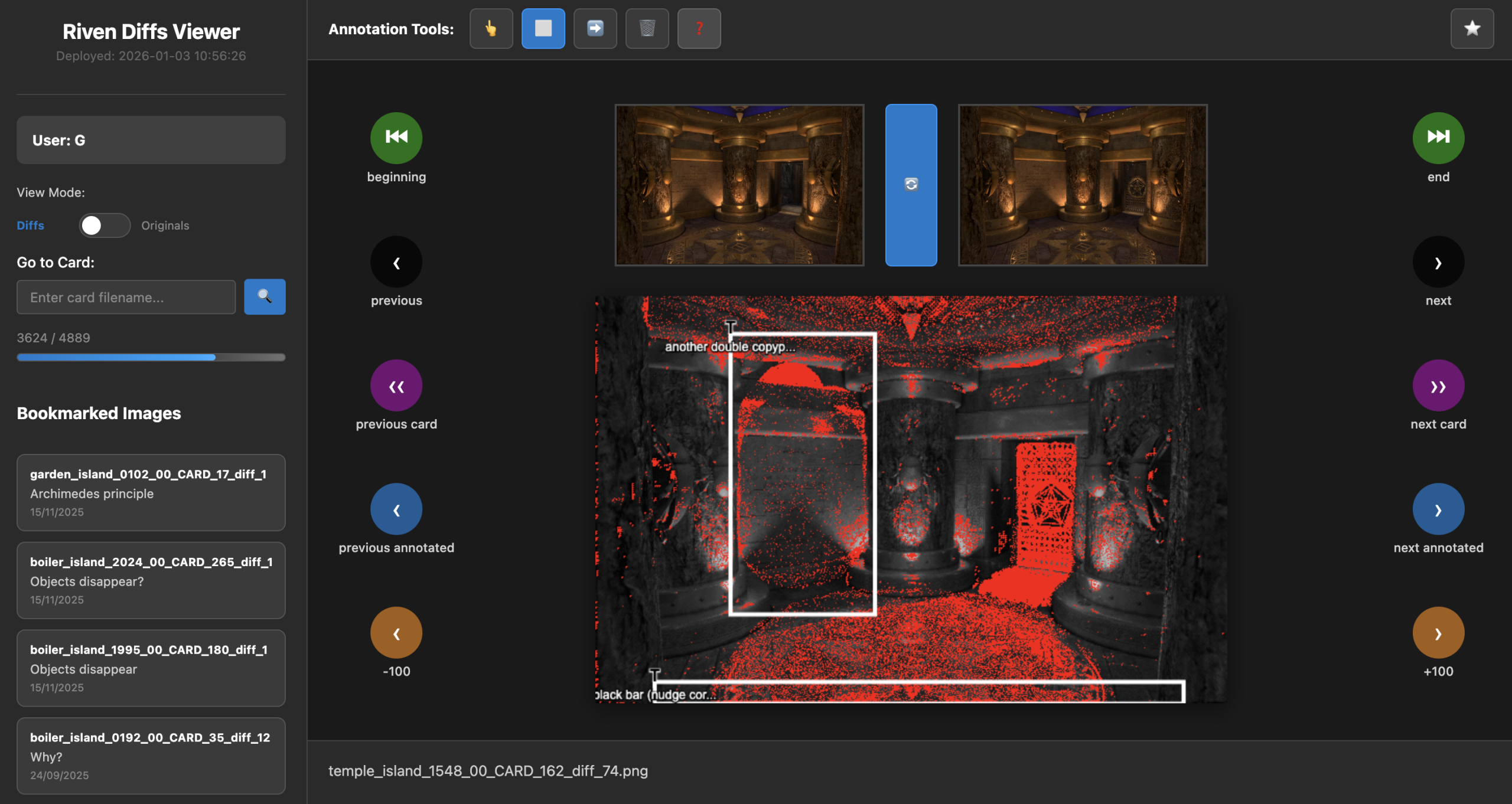
A detailed inspection of Riven’s game assets found that, unlike Myst’s static one-image-per-card approach, Riven’s Mohawk engine stores multiple rendered versions for the same camera position. The author and collaborators built a “Riven Explorer” to compare those renders directly, producing visual “diffs” that reveal subtle differences produced at different points in development or under different worldstates. The tool creates pairwise comparisons for every render combination on a card, showing mismatches either as highlighted pixels or as a rapid toggle animation. Systematic scans of Jungle Island reveal numerous anomalies tied to dome states, foliage changes, visible splices, and patches used for overlays like a submarine and a dock. The write-up documents specific cards and examples where geometry, lighting, and composition differ between renders, and it frames these findings as a way to see the same place across multiple temporal or development states.
Why it matters
- Exposes how the Mohawk engine accommodates multiple renders per camera position, giving insight into Riven’s technical design.
- Reveals development artifacts (splices, patches, render-stage changes) that illuminate the game’s production process.
- Provides new ways to inspect and preserve visual history of classic games by comparing alternate renders in-place.
- Helps differentiate between intentional worldstate-driven visuals and accidental rendering quirks that were baked into final assets.
Key facts
- Riven’s engine (Mohawk) can assign multiple renders to a single card; Myst’s HyperCard model used one static view per card.
- The Riven Explorer compares all pairwise render combinations on a card, producing diffs for A vs B, A vs C, B vs C, etc.
- Two visualization modes are used: a pixel-differential composite (mismatches highlighted) and an animated toggle between images.
- The number of diffs for N renders follows the triangular-number sequence: 0, 1, 3, 6, 10…
- Research used asset extraction filenames aligned to the numbering produced by the Riveal tool by Ron Hayer.
- Card numbering referenced in the article is based on the English 1.2 10th Anniversary DVD; other releases may use different indices.
- Concrete Jungle Island findings include dome hinge occlusion anomalies on cards J121, J124, J133, J154, and J421.
- Other documented behaviors: dome base movement in J130; major foliage changes in J110, J119, and J127; a Spyder easter-egg render affecting J154.
- Patches are used in places such as J181 to overlay submarine and dock visuals; splices are visible in examples like J191.
What to watch next
- Further articles in this series that will examine more anomalies and islands (confirmed in the source as forthcoming).
- Whether additional islands show systematic issues similar to the dome-related anomalies on Jungle Island (not confirmed in the source).
Quick glossary
- Anomaly: A visible rendering quirk in a render, which can stem from geometry changes, splices, or other mismatches between renders.
- Card: A discrete location where the player can stand; a card may hold multiple renders representing different worldstates.
- Worldstate: The set of all player-actionable elements (lever positions, doors, elevators) that define the current state of the game world.
- Patch: A rectangular image or video overlaid in real time onto a background render to represent elements that change between worldstates.
- Splice: A modification where part of one render’s image data has been copied into another render, creating differences baked into the final image.
Reader FAQ
What is the Riven Explorer?
A tool developed to display side-by-side and differential comparisons between multiple renders assigned to the same card.
Does this research change how Riven plays in its released form?
not confirmed in the source
Are the card numbers shown consistent across releases?
Card numbers in the article use the English 1.2 10th Anniversary DVD indexing; other releases or languages may use different numbers.
Were external tools used to extract assets?
Yes — the research used filenames produced by the Riveal asset extraction tool by Ron Hayer (as stated in the source).
Does the article include spoilers?
The article contains spoilers applicable to both versions of Riven (stated in the source).
The Riven Diffs Seeing Riven (1997) Differently Updated January 3, 2026 • 11 min read Guillaume Lethuillier Opinions expressed in this blog are solely my own and do not express…
Sources
- The Riven Diffs – Seeing Riven (1997) Differently
- Differences between Riven 1997 and Riven 2024
- Riven review: Polished puzzle-solving
- The Riven Journals Restored | Realm of RIUM+
Related posts
- Assessing Every-Third-Day Versus Daily Low‑Dose Aspirin: Comparative Benefits
- The Suck Is Why We’re Here: On Writing, AI and Creative Work
- The Riven (1997) Diffs: Seeing Riven Differently Through Render Analysis