
TL;DR
A developer benchmark found that C# code running under Unity’s Mono can be multiple times slower than the same code on modern .NET runtimes. Unity has discussed porting to CoreCLR for years; the runtime modernization is planned for Unity 6.x but not expected to be production-ready in 2026.
What happened
A developer compared execution of simulation code that does not depend on Unity APIs when run under Unity’s Mono runtime versus modern .NET. Using the same project compiled in Debug, the Unity editor run took about 100 seconds while a .NET unit-test run finished in roughly 38 seconds. In standalone Release builds the gap remained: a Mono standalone ran in about 30 seconds versus 12 seconds for .NET. The tests were performed with recent toolchains (benchmarks used Unity 6.0 and .NET 10). The author traced the differences to runtime and JIT optimizations, and showed examples where Mono generated less efficient machine code. The piece also reviews Unity’s long-running effort to modernize its managed runtime (CoreCLR), notes Unity’s Burst compiler and IL2CPP as current alternatives, and reports that CoreCLR support is on the Unity 6.x roadmap but not slated to be production-ready in 2026.
Why it matters
- Measured runtimes show 1.5–3x typical speedups and, in some microbenchmarks, much larger gains — real projects can see significant performance differences.
- Slower managed-code execution can lengthen editor iteration and debug turnaround times, affecting developer productivity.
- CoreCLR would enable newer JIT optimizations, hardware intrinsics, Span<T>-style APIs and SIMD paths that current Mono lacks.
- Until runtime modernization ships, projects that rely heavily on managed code carry an ongoing performance tax that isn’t visible in typical editor workflows.
Key facts
- Unity historically uses the Mono framework to run C# and selected it in the mid-2000s for cross-platform needs.
- Microsoft began open-sourcing .NET and shipped .NET Core 1.0 in 2016; the ecosystem has since introduced a newer CLR and JIT improvements.
- Benchmarks cited used Unity 6.0 and .NET 10 for direct comparisons.
- Debug-mode comparison: Unity editor (Mono) ~100s vs .NET unit test ~38s for the same simulation code.
- Release-mode standalone comparison: Mono ~30s vs .NET ~12s on the same workload.
- Author reports common project-level speedups of 1.5–3x, and measured microbenchmarks with up to ~15x differences.
- Unity has discussed porting to CoreCLR since around 2018; CoreCLR work is on the Unity 6.x roadmap but not production-ready in 2026 according to the company.
- Unity’s Burst compiler uses LLVM to produce optimized native code but supports only a restricted subset of C#.
- IL2CPP remains Unity’s current solution for ahead-of-time (AOT) compilation, and Unity staff indicated CoreCLR AOT is not planned.
What to watch next
- Progress and release notes for Unity 6.x indicating when CoreCLR support becomes production-ready.
- Performance comparisons and tooling updates from Unity showing how CoreCLR affects editor and runtime iteration times.
- not confirmed in the source
Quick glossary
- Mono: An open-source implementation of the .NET runtime historically used by Unity to run C# code across platforms.
- CoreCLR: The cross-platform Common Language Runtime implementation used by modern .NET that includes newer JIT and runtime optimizations.
- JIT (Just-In-Time compiler): A compiler that translates intermediate code into machine code at runtime, optimizing based on execution contexts.
- AOT (Ahead-Of-Time compilation): Compilation of intermediate code to native machine code before execution, which can improve startup time and meet platform restrictions on JIT.
- IL2CPP: Unity’s tool that converts .NET intermediate language to C++ which is then compiled to native code, used for AOT scenarios.
- Burst: Unity’s LLVM-based compiler that transforms certain annotated C# methods into highly optimized native assembly with restrictions on supported patterns.
Reader FAQ
Is Mono actually slower than modern .NET?
According to the reported benchmarks, Mono executed the same simulation code substantially slower than .NET in both Debug and Release runs.
How large were the measured performance gaps?
The author recorded about 100s vs 38s in Debug and about 30s vs 12s in Release for the tested workload; they report typical project speedups of 1.5–3x and microbenchmark spikes up to ~15x.
Will CoreCLR arrive for Unity soon?
Unity has placed .NET modernization on the Unity 6.x roadmap but indicated CoreCLR would not be production-ready in 2026.
Can Burst or IL2CPP replace the need for CoreCLR?
Burst can produce high-performance native code for limited C# patterns and IL2CPP provides AOT compilation, but both have trade-offs; whether they fully substitute CoreCLR is not confirmed in the source.
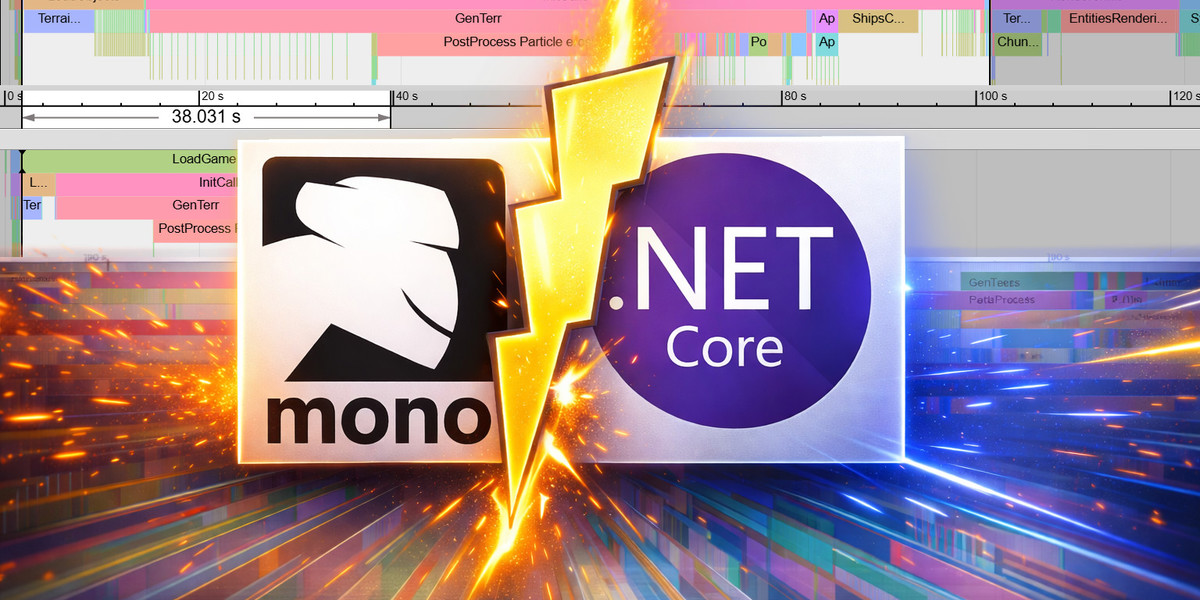
Unity's Mono problem: Why your C# code runs slower than it should Posted 27 Dec 2025 By Marek Fiser 10 min read Execution of C# code in Unity’s Mono runtime…
Sources
- Unity's Mono problem: Why your C# code runs slower than it should
- Unity Future .NET Development Status – Page 105
- Why Unity uses Mono as the runtime environment
- c# – Mono vs .NET in Unity
Related posts
- Parsing IP Addresses Quickly and Portably – Without SIMD Magic Techniques
- Why You Should Keep AI Out of Your Cognitive ‘Gym’ — A Practical 2026 Rule
- Phantas: Browser-based binaural strobe engine using the Web Audio API