
TL;DR
The Pickle Robot Company, founded by MIT alumni, builds one-armed autonomous systems that unload trailers, handling packages up to 50 pounds and moving them onto onboard conveyors. The machines combine machine vision, sensors and fine-tuned generative AI models and are already in pilots and deployments with logistics customers.
What happened
Pickle Robot Company has developed mobile, one-armed robotic systems designed to autonomously unload trucks and shipping containers. The robots use a KUKA industrial arm mounted on a custom mobile base, an onboard computer, cameras, sensors and a suction gripper to pick packages (from about 5-inch cubes to 24-by-30-inch boxes) and place them on an onboard conveyor. The systems are trained with a mix of pre-trained generative AI and smaller specialized machine-learning models so they can operate in new trailer environments on day one and improve over time. After an early proof-of-concept video generated strong customer interest, the company piloted deployments — including a year-long trial in a hot California site — and has scaled to multiple customers such as UPS, Ryobi Tools and Yusen Logistics. Pickle employs roughly 130 people from its Charlestown, Massachusetts headquarters and is expanding its product roadmap to include integrations with third-party robots and a planned two-armed design.
Why it matters
- Automates repetitive, physically demanding unloading tasks linked to high warehouse injury rates, potentially reducing worker exposure to hazardous conditions.
- Enables operations in extreme environments (example: shipping containers that become very hot) where human labor is costly or risky.
- Integrates AI and off-the-shelf industrial hardware to deliver a deployable system that can operate in varied trailer layouts on day one.
- Positions robotic systems as parts of a broader supply-chain orchestration effort linking unloading, palletizing, forklifts and inventory platforms.
Key facts
- Company founded by MIT alumni AJ Meyer, Ariana Eisenstein and Dan Paluska.
- Robots pick boxes weighing up to 50 pounds.
- Can handle boxes from roughly 5-inch cubes up to 24-by-30-inch sizes.
- Unloading throughput ranges from about 400 to 1,500 cases per hour depending on size and weight.
- Hardware includes a KUKA industrial arm, suction gripper, custom mobile base and onboard computing.
- Software stack combines fine-tuned pre-trained generative AI models with multiple smaller ML models plus cameras and sensors.
- Early pilot included a year-long deployment in California; customers include UPS, Ryobi Tools and Yusen Logistics.
- Company employs around 130 people and runs facilities in Charlestown, Massachusetts.
What to watch next
- Ramp-up of production for a new version of the system this summer, as announced by the company.
- Development timeline and engineering work toward a two-armed robot planned after the current production increase.
- Progress on the company’s software platform to integrate third-party robots (forklifts, palletizers, humanoid platforms) and whether those integrations are realized at scale.
- Not confirmed in the source: specific macroeconomic or workforce impacts from broader deployment (job losses, retraining programs, labor market effects).
Quick glossary
- Generative AI: Machine-learning models that produce new content or outputs, often used as bases that can be adapted and fine-tuned for specific tasks.
- Machine vision: The use of cameras and software to let machines interpret and navigate physical environments by recognizing objects, depth and features.
- Suction gripper: An end-effector that uses vacuum or suction to pick up and hold items, commonly used in robotic material-handling applications.
- Onboard computing: Computational hardware located on a robot or mobile platform that processes sensor data and runs control and perception algorithms in real time.
- KUKA: A German industrial robotics company whose articulated robotic arms are commonly used in manufacturing and automation.
Reader FAQ
What tasks do Pickle robots perform?
They autonomously unload trailers and move packages onto an onboard conveyor, handling a range of box sizes and weights up to 50 pounds.
Who founded the Pickle Robot Company?
The company was founded by MIT alumni AJ Meyer, Ariana Eisenstein and Dan Paluska.
Are these robots fully autonomous in new trailers on day one?
The company says its combination of sensors, machine vision and fine-tuned AI lets the robots operate in new trailer environments on day one and improve over time.
Will Pickle’s robots replace human warehouse workers?
Not confirmed in the source that robots will replace humans; a company co-founder described robots as handling repetitive, brute-force tasks while humans solve edge cases and more adaptable problems.
How much do the systems cost?
Not confirmed in the source.
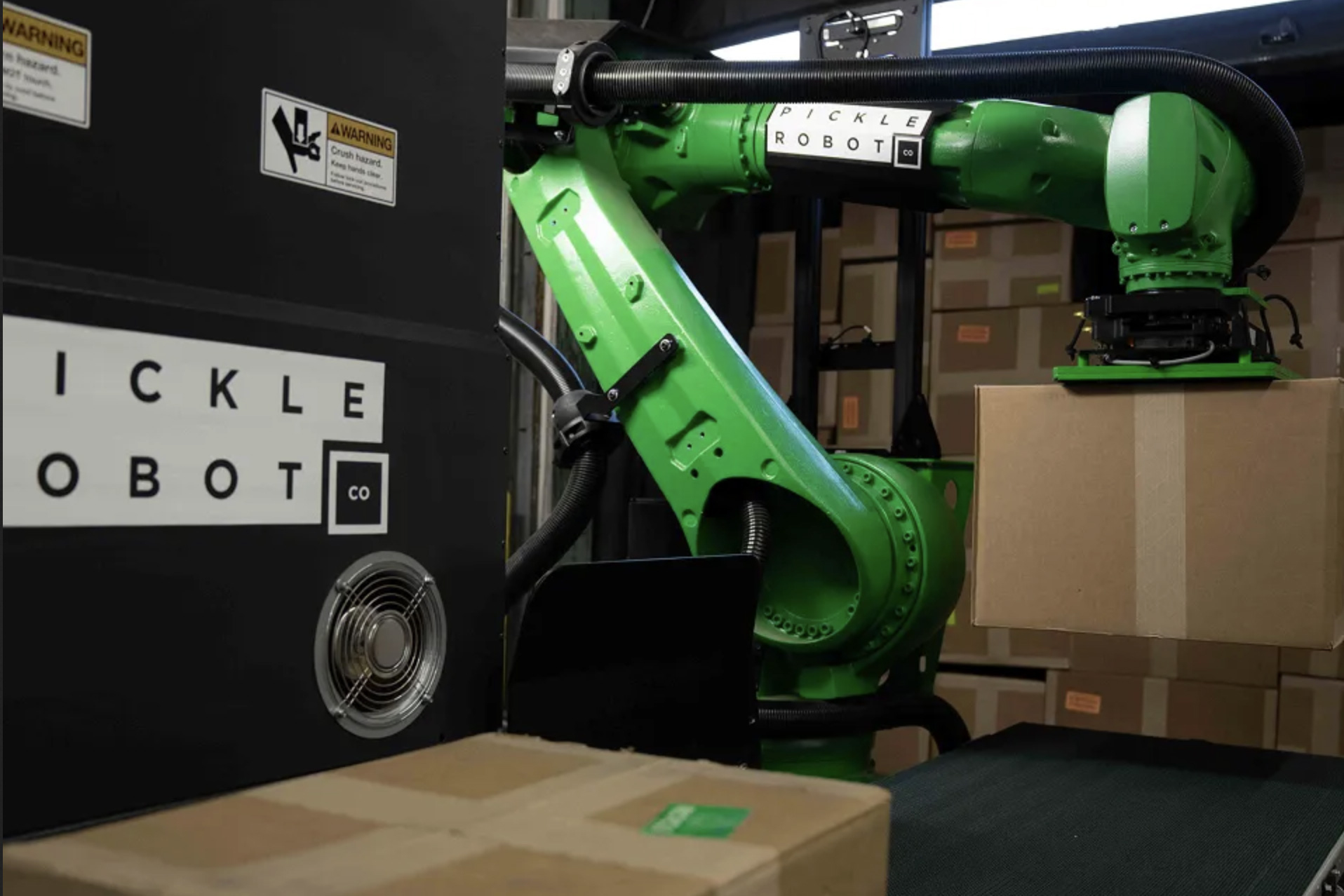
Founded by MIT alumni, the Pickle Robot Company has developed machines that can autonomously load and unload trucks inside warehouses and logistic centers. Watch Video Zach Winn | MIT News…
Sources
- Robots that spare warehouse workers the heavy lifting
- Pickle Robots Unload Trucks
- Generative-AI robot unloads trailers at 1500 boxes per hour
- Pneumatic-suction robot clears 75000 lb of cargo an hour
Related posts
- MIT researchers develop speech-to-reality system that fabricates objects
- Student-built NerdXing helps MIT undergrads navigate cross-department paths
- Japanese Team Builds a Chip That Claims to Outsmart You in Rock-Paper-Scissors