
TL;DR
Public, angry feedback often mixes factual complaints with emotional regulation; responding with defense usually escalates the situation. The piece uses a recent CodeRabbit episode to show how owners can de-escalate by listening, taking responsibility, and clarifying rather than rebutting.
What happened
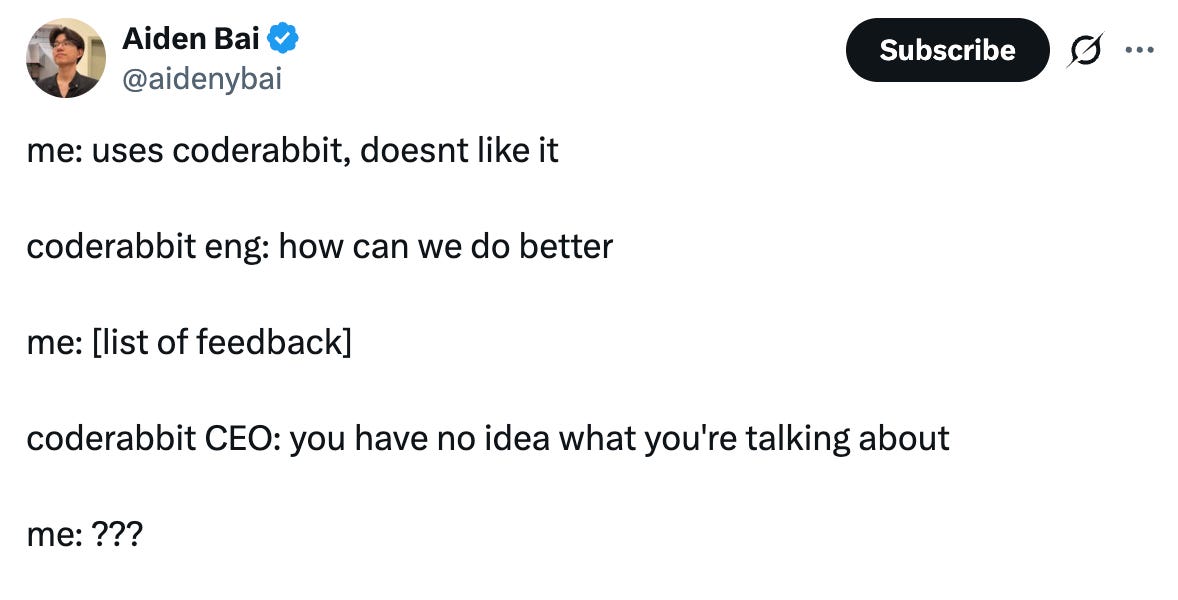
The author frames negative public feedback as a kind of reputational "thermostat": people attempt to correct what they see as an off-kilter perception by venting. That dynamic separates the informational content of a complaint from the complainant’s need to be heard. The essay illustrates the point with a recent incident involving CodeRabbit: a user, Aiden Bai, posted grievances; an engineer asked for details and the user supplied them. The company’s CEO, Harjot, then replied in a way the author calls condescending — dismissing the user as clueless, implying volume of users made the complaint irrelevant, suggesting the problem could be solved with simpler controls and handholding, and insulting indie developers. The reply provoked further backlash, drew sympathetic onlookers, and, according to the author, created "bad vibes" for CodeRabbit while giving competitors an opening. The episode ended with a partial apology from the CEO.
Why it matters
- Public criticism is as much about being heard as it is about the facts; failure to address the emotion can magnify reputational damage.
- Defensive or condescending replies tend to provoke escalation and encourage onlookers to side with the critic.
- A founder’s tone and accountability can determine whether feedback de-escalates or becomes a broader PR problem.
- Handling complaints well reduces the incentive for people to "twist the thermostat" harder and can preserve customer relationships.
Key facts
- Article by Lulu Cheng Meservey, published December 29, 2025 on Flack.
- The author describes public complaints as a "thermostat" for credibility that people use to regulate reputation.
- Example used: a public complaint by user Aiden Bai about CodeRabbit.
- A CodeRabbit engineer initially asked for feedback and the user provided more context.
- CodeRabbit’s CEO, Harjot, replied in a way the author characterizes as dismissive and insulting to the user and indie developers.
- The CEO’s response led to further backlash, created "bad vibes" for CodeRabbit, and was framed as a win for competitors.
- The episode concluded with a partial or tentative apology from the CEO, described in the piece as an "apologish."
- Author guidance: separate emotion from information, align on principles first, overindex on accountability, explain rather than defend, and offer straightforward apologies when warranted.
What to watch next
- Customer sentiment and public replies after an initial defensive response (likely to grow if not addressed).
- Whether leadership follows up with a clear, accountable statement or only a partial apology.
- Not confirmed in the source: long‑term customer churn or financial impact from the episode.
- Not confirmed in the source: whether competitors materially benefited beyond short‑term PR advantage.
Quick glossary
- Public feedback: Comments or complaints about a product or company made openly on social platforms, forums, or other visible channels.
- Escalation: The process by which a disagreement or complaint grows in intensity, often drawing more participants and stronger language.
- Accountability: Taking responsibility for problems or mistakes and explaining steps to remedy them and prevent recurrence.
- Apology: A statement acknowledging harm or error; when appropriate it should be concise, take responsibility, and outline corrective action.
- Thermostat analogy: A metaphor used to describe how audiences try to "adjust" a company’s reputation to what they consider the correct level.
Reader FAQ
What should a founder do first when faced with public negative feedback?
Begin by separating the emotional element from the substantive criticism: listen, acknowledge the frustration, and align on shared principles before discussing facts.
Is apologizing always the right move?
Not always; the piece advises that if an apology is warranted it should be straightforward and accountable, but sometimes a different approach is appropriate.
Did CodeRabbit suffer lasting damage from the incident?
Not confirmed in the source.
Will defending facts ever help?
The author argues that fact‑checking without first addressing the complainant’s frustration typically backfires; clarify and explain after resolving the emotional component.
Discover more from Flack A new playbook for communications Subscribe By subscribing, I agree to Substack's Terms of Use, and acknowledge its Information Collection Notice and Privacy Policy. Already have…
Sources
- When someone says they hate your product with a burning passion
- Receive A Negative Public Review? Here's The Best Way …
- Turning Haters into Fans: How to Respond to Negative …
- 5 WAYS TO HANDLE NEGATIVE COMMENTS ABOUT …
Related posts
- Production failure from uninitialized C++ struct exposed undefined behavior
- Static memory allocation in Zig: building a Redis-compatible kv server
- How to adjust what online platforms show you: tuning algorithms