
TL;DR
Writer Daniel Miessler argues people must distinguish tasks they want AI to perform from those they should keep for their own development. He proposes treating core cognitive work as 'gym' exercises and using AI as a Socratic tutor to maintain and sharpen those skills.
What happened
In a late-2025 essay, Daniel Miessler lays out a framework for where to accept AI assistance and where to refuse it. He uses a 'Job vs. Gym' analogy: jobs are output-oriented tasks where the outcome matters more than who did the lifting, while gym work is practice-oriented and intended to build ability. Miessler identifies activities such as critical thinking, problem solving, and constructing arguments as gym tasks that are central to his professional identity. To preserve those skills, he has begun building a personal AI workflow that functions both as a worker and as a tutor. That system — centered on a digital assistant named Kai — reviews gym tasks the AI helped on and then quizzes the author on the decisions, code, and reasoning behind them. The current implementation uses a Claude code skill, and Miessler recommends others map their skills into Job and Gym categories and either restrict AI on gym work or add systems to keep practicing.
Why it matters
- Using AI for practice-oriented tasks risks eroding the very skills people rely on to define their work and identity.
- Distinguishing between outcome-driven tasks and skill-building tasks helps preserve critical thinking and problem-solving abilities.
- Designing AI interactions as tutoring systems can enable learning while still benefiting from automation.
- Without intentional boundaries, people may inadvertently outsource core cognitive exercises to tools that can perform them faster.
Key facts
- Miessler framed his guidance around a 'Job vs. Gym' distinction for tasks and AI use.
- He classifies critical thinking, problem solving, and argument construction as examples of Gym tasks.
- The author is building a personal AI setup that doubles as a tutor to interrogate his understanding of work the AI assisted with.
- His assistant is called Kai and currently uses a Claude code skill for interactive review sessions.
- Weekly sessions involve Kai reviewing gym-related work the AI performed and asking probing questions about decisions and architecture.
- Miessler's practical recommendation: inventory your skills, label them Job or Gym, and either reduce AI doing Gym work or create systems to keep those muscles active.
- A small note in the piece mentions Kai produced an art piece using a likeness of the author.
- The essay was presented as a forward-looking guideline for approaching AI help into 2026.
What to watch next
- Whether other knowledge workers adopt assistant-as-tutor workflows similar to Miessler's — not confirmed in the source.
- Development of dedicated tools or interfaces for Socratic-style AI tutoring beyond the Claude code skill Miessler mentions — not confirmed in the source.
- Organizational or cultural shifts that redefine which cognitive tasks are expected to be performed by humans versus AI — not confirmed in the source.
Quick glossary
- Job vs. Gym distinction: A framework separating outcome-oriented tasks (Job) from practice-oriented tasks intended to build skill (Gym).
- Digital Assistant: A software agent that automates tasks, can track activity, and interact with the user to provide help or feedback.
- Socratic tutoring: A teaching approach using questions to probe understanding and encourage the learner to articulate reasoning and principles.
- AI stack: The set of tools, models, and integrations a person or organization uses to deploy and manage AI capabilities.
- Claude code skill: A referenced code-oriented capability or integration used to perform programming-related tasks and interactions in an AI system.
Reader FAQ
What does 'Keep the robots out of the gym' mean?
It means avoid letting AI do tasks you deliberately use to practice and improve your cognitive skills.
Does Miessler stop using AI for cognitive work entirely?
No. He still uses AI but pairs it with a tutoring workflow so he remains engaged in the reasoning — not confirmed in the source as a full stop to AI use.
Is Kai an off-the-shelf product?
Not confirmed in the source.
How does the tutoring session work?
Kai reviews gym tasks the AI performed and asks questions about how and why decisions were made, probing to first principles and code-level details.
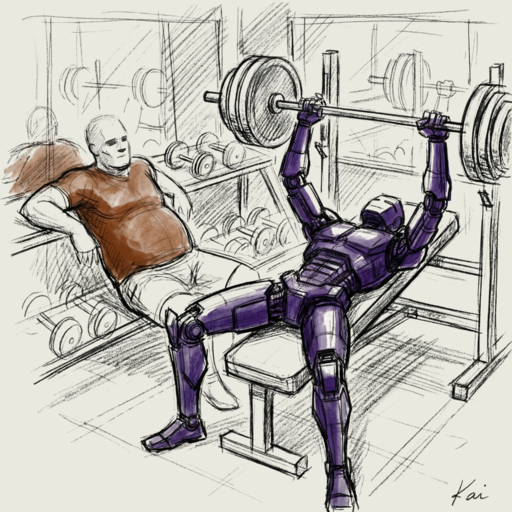
DANIEL MIESSLER Keep the Robots Out of the Gym Be careful where you get help from AI November 24, 2025 #ai #productivity #future #must AI is getting so good now…
Sources
- Keep the Robots Out of the Gym
- AI Trends for 2026: Building 'Change Fitness' and Balancing …
- Emotional AI in the NHL: Psychometrics & Cognitive …
- How AI Training Preserves Critical Thinking
Related posts
- Phantas: Browser-based binaural strobe engine using the Web Audio API
- Pion SCTP With RACK: 71% Throughput Gain and 27% Lower Latency
- The Prison of Financial Mediocrity: Why Young People Gamble for Agency